ExecSignals vs Salary Surveys
An honest comparison for executive recruiters evaluating their sourcing stack.
Salary Surveys
Strengths
- Deep historical data
- Trusted methodology
- Good for benchmarking presentations
Limitations
- Annual updates (stale)
- No individual role alerts
- No hiring signals
- Backward-looking, not real-time
ExecSignals
What You Get
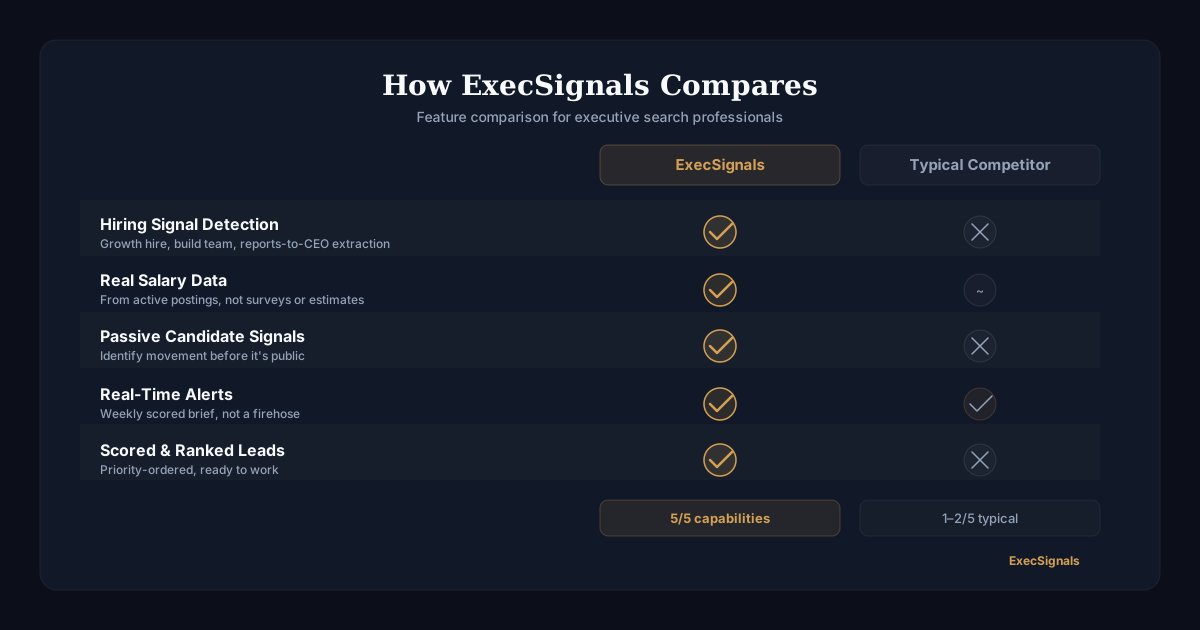
- Scored and ranked VP+ leads
- Real salary data from active postings
- Hiring signal extraction (growth hire, build team, reports to CEO)
- Weekly market intelligence (salary benchmarks, velocity, geo trends)
- Excel workbook + PDF one-pager included
- $297/mo, no contract
Pricing Comparison
Salary Surveys costs $2,000-10,000/yr. ExecSignals costs $297/month with no annual contract and no per-seat licensing. You can cancel anytime. The question is not which tool is cheaper. The question is which tool returns more in placement fees per dollar spent.
A single executive placement at the VP level typically generates $60,000-$100,000 in fees for the recruiting firm. If ExecSignals helps you identify and close one additional placement per quarter that you would have otherwise missed, the return on a $297/month subscription is north of 50x. The same math applies to Salary Surveys at $2,000-10,000/yr, but only if you are actively converting the capabilities it offers into closed searches.
Most executive recruiters spend more on lunch per month than they spend on sourcing intelligence. The recruiters who consistently outperform their peers are the ones who invest in better information, not just bigger networks. The cost of missing a single high-value placement because you did not see it in time is far greater than the annual cost of any tool on this page.
When to Use Salary Surveys
Salary Surveys is the stronger choice when you need deep historical data. If your workflow already depends on trusted methodology, switching away creates friction that may not be worth the tradeoff. Salary Surveys has built its reputation on these capabilities, and for recruiters who rely on them daily, it remains a solid tool.
The limitation is what Salary Surveys does not do. Annual updates (stale). No individual role alerts These gaps mean you still need another source for market intelligence, compensation benchmarks, and prioritized lead lists. That is where the two tools complement each other rather than compete.
When to Use ExecSignals
ExecSignals is the better fit when you want scored, ready-to-work VP+ leads with salary data and hiring signals delivered every Monday. There is no searching, no scanning, and no boolean queries required. You open The Monday Brief and see exactly which roles are worth pursuing, ranked by quality and urgency.
If your biggest bottleneck is deciding which opportunities to pursue rather than finding candidates for known roles, ExecSignals solves that problem directly. Every lead comes with the salary budget, the hiring signal (growth hire, build team, reports to CEO), and enough context to make a go or no-go decision in under a minute.
Many recruiters use both. ExecSignals handles the "which roles to pursue" question. Salary Surveys handles other parts of the workflow. The two tools address different stages of the search process, and there is no conflict in running them side by side.
The subscription is $297/month with no annual contract, no per-seat fees, and no onboarding period. You sign up, receive your first Monday Brief within a week, and start working the leads immediately. If it does not work for you, cancel anytime. There is no penalty and no long-term commitment. That makes it easy to test the value before making a larger commitment to your sourcing stack.
What Sets ExecSignals Apart
Most tools in the executive search space focus on candidate data. ExecSignals focuses on opportunity data. Instead of giving you a database of people to contact, it gives you a ranked list of roles worth pursuing, with the salary budget, hiring signal, and company context attached to each one. That shift in focus changes how recruiters spend their time. Less searching. More selling. More closing.
Every lead is scored and ranked. That scoring takes into account the salary range, the hiring signal strength, the company profile, and the urgency of the hire. High-scoring leads are the ones most likely to result in a successful placement. That is the kind of prioritization that no amount of manual job board scanning can replicate consistently.
The delivery format matters too. ExecSignals arrives as an Excel workbook and a PDF one-pager every Monday morning. There is no platform to log into, no dashboard to configure, and no learning curve. You open the file and get to work. For busy recruiters managing multiple active searches, that simplicity is the point.
The Bottom Line
Salary Surveys and ExecSignals solve different problems. Salary Surveys gives you deep historical data, which matters if that is the part of your process that needs improvement. ExecSignals gives you a prioritized list of executive opportunities with salary data and hiring signals, which matters if your bottleneck is knowing which roles to pursue in the first place.
The best executive recruiters do not rely on a single tool. They build a stack that covers sourcing, intelligence, and relationship management. If Salary Surveys handles one piece of that stack well, keep it. Add ExecSignals to cover the piece it does not. Your first week is free, so you can evaluate the fit with zero risk.
Frequently Asked Questions
Compare ExecSignals to Other Tools
Evaluating your sourcing stack? See how ExecSignals stacks up against the other tools executive recruiters use.